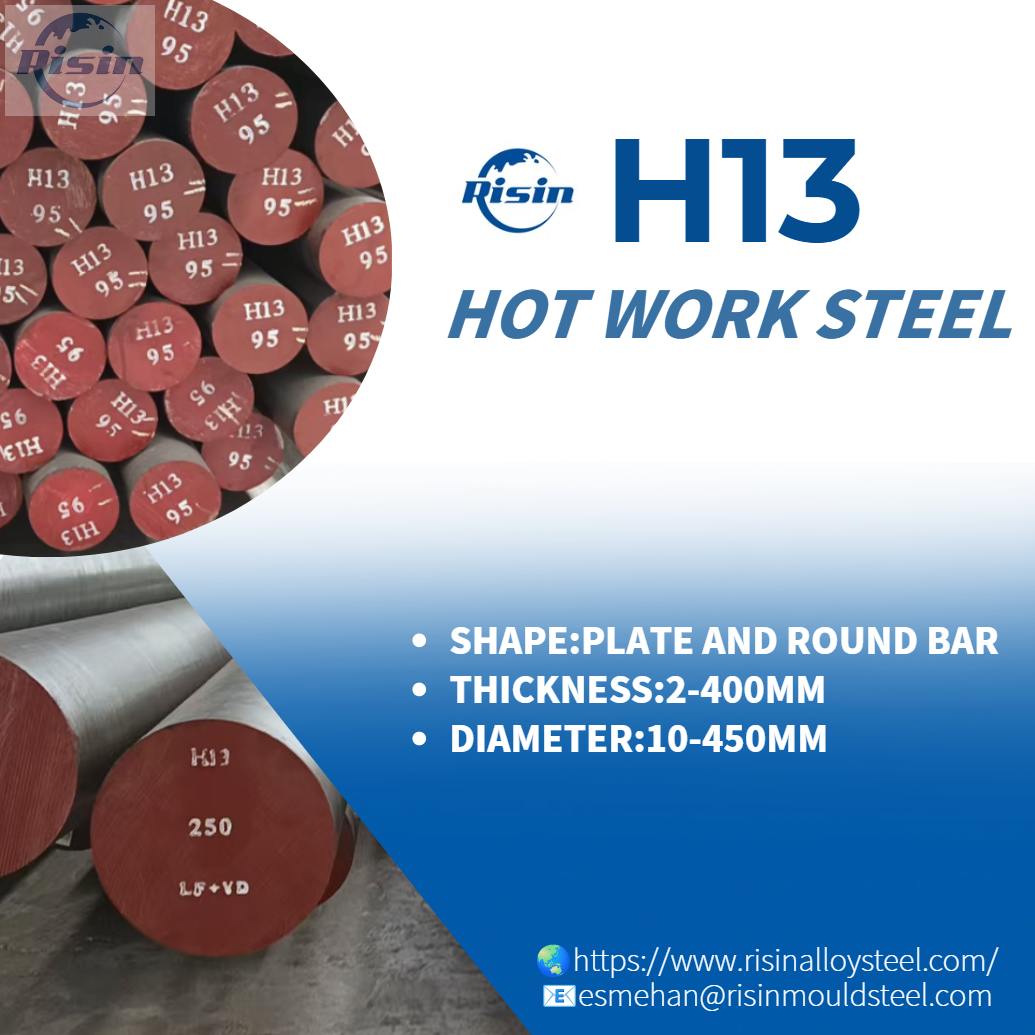
In the field of hot work tooling, H13 has firmly established itself as the material of choice for aluminum-magnesium die casting, hot extrusion, and hot forging dies, thanks to its superior red hardness, thermal fatigue resistance, and toughness. However, when facing molds of different shot counts and sizes, simply knowing that “H13 is needed” is far from enough. Should you choose rolled or forged plate? How do you ensure consistent performance across thicknesses ranging from 2mm thin inserts to 400mm large die bases, and round bars from 10mm ejector pin stock to 450mm extrusion sleeves? When exporting to markets such as Russia, India, and South America, what standards and surface conditions should be matched?
This article starts from the essential characteristics of H13 and, combined with the product forms and processes actually available from Risin, reveals how to truly unlock the performance potential of H13 hot work tool steel through correct material selection and specification matching

H13 is the ASTM designation for this classic hot work steel. Its excellent universality has given it many “names”: Chinese GB 4Cr5MoSiV1, Japanese JIS SKD61, German DIN 1.2344, Swedish 8407. Whether procured under the GOST system familiar to the Russian market, or according to ASTM or DIN standards in India and South America, the chemical composition core remains highly consistent.
Typical composition:

This medium-carbon, high chromium-molybdenum-vanadium combination lays the foundation for its high-temperature strength and resistance to temper softening. Every batch of H13 supplied by Risin, whether rolled thin plate or forged thick plate, comes with a traceable heat number and spectrometer composition report, ensuring transparency in cross-border trade quality.

H13 must directly face the washout of molten aluminum above 600°C and repeated cycles of rapid heating and cooling. Its core value lies in:
Thermal Fatigue Resistance: Stable carbides produced by the appropriate Cr, Mo, V ratios make the mold less prone to craze cracking under repeated thermal shocks. This characteristic directly determines whether a die casting mold achieves 30,000 shots or 100,000 shots.
Red Hardness: It can maintain a working hardness of HRC 46-50 at around 600°C, resisting thermoplastic deformation.
Hardenability and Toughness: Large cross-section molds achieve a uniform martensitic structure from the surface to the core. Especially for forged products, the forging process breaks up carbides and densifies the structure, further improving toughness, which is crucial for hot forging dies subjected to severe impact.

The performance of H13 steel depends not only on chemical composition but also closely on the forming method. Risin can supply you with both rolled and forged process routes for plates and round bars, with a dimensional coverage that is extremely competitive among similar suppliers:
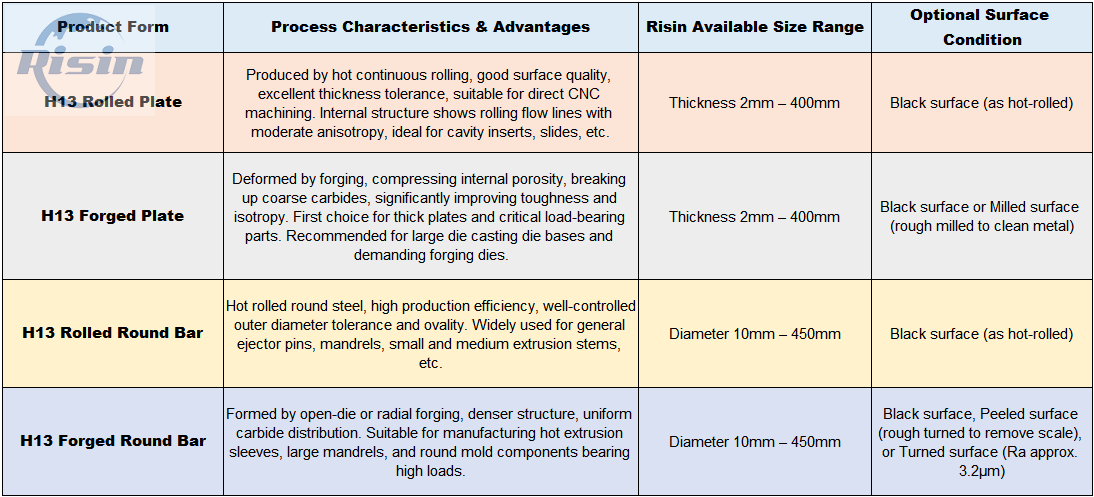
Why does this size range and surface condition matter to you?
H13 rolled plate 2mm black surface: Used for precisely cut mold inserts and hot shear blades, can be directly wire-EDM cut; you can grind it clean yourself for optimal cost efficiency.
H13 forged plate 400mm milled surface: Large die casting mold frames and bases require a flat reference surface. Choosing milled delivery saves you the heavy rough milling process, allowing you to proceed directly to finish machining or heat treatment, while the decarburization layer has been reliably removed.
H13 round bar 10mm to 450mm with three surface finishes: Small ejector pin stock can be directly turned from black surface rolled round bars. For extrusion sleeves requiring strict decarburization control or efficient machining, forged round bars in peeled or turned condition are recommended, offering consistent dimensions and uniform stock allowance. All products are conventionally delivered in as-rolled or as-forged random lengths, allowing you flexible nesting; fixed-length saw cutting can also be negotiated.

Risin’s H13 products are consistently exported to markets including Russia, India, and South America. Each region has its specific emphasis on tool steel:
Russia: Prefers GOST standard equivalent grades and often requires guaranteed low-temperature impact toughness. We can provide impact energy values at -20°C or -40°C to match the service conditions of molds in cold regions. (H13 steel GOST Russia)
India: Has a huge die casting and extrusion market, high recognition of DIN 1.2344 / SKD61, and strict requirements for plate thickness tolerance and surface decarburization layer control. Our rolled plates achieve tight thickness tolerances, while milled forged plates and turned/peeled forged round bars effectively control decarburization depth, perfectly meeting the high standards of local mold shops for incoming material surface quality. (H13 steel supplier India)
South America: Largely follows the ASTM system, accepting ASTM A681 H13. We can fine-tune composition according to ASTM standards from the ingot melting stage and provide bilingual (English/Spanish) inspection certificates. We also support both black surface and rough-machined deliveries to meet the needs of mold workshops of various scales locally. (H13 tool steel South America)
Furthermore, Risin possesses flexible logistics packaging capabilities. Whether it's black rolled plates in sea containers, or milled forged plates and turned forged round bars secured in wooden crates, all are properly rust-proofed and damage-proofed, ensuring the material arrives at your overseas warehouse in its original condition.
 In the market, H13 material is not scarce, but suppliers that combine comprehensive specifications, controllable processes, professional service, and rich export experience are few and far between. This is precisely why Risin has become a long-term partner for many overseas customers:
1. True Full-Size Coverage, One-Stop Sourcing
Whether you need a 2mm thin precision insert strip or a 400mm thick large die base; from a 10mm small-diameter ejector pin round bar to a 450mm large cross-section extrusion sleeve forged round bar, we can deliver from a single plant. You no longer need to source thin and thick plates from different suppliers, significantly reducing communication and logistics costs.
2. Dual Paths of Rolling & Forging, Matching Needs Without Over-Selling
We supply both rolled and forged plates, as well as rolled and forged round bars. We can recommend the most economical solution based on the actual stress state and cost budget of your mold. For instance, ordinary slides can use rolled plate, while critical cavities and mold frames should use forged plate. We are committed to helping you spend money where it counts, not simply recommending the most expensive product.
3. Strict Quality Control and Full Traceability
Every batch of H13 undergoes ladle furnace refining and vacuum degassing, and can be upgraded to electroslag remelting (ESR) upon request. Before shipment, each batch is tested by spectrometry, ultrasonic testing (UT), hardness testing, and decarburization layer inspection. All material carries a unique heat number, enabling full traceability from the steel mill to your hands.
4. Global Market Access, No Language Barrier for Documentation
With deep understanding of markets like Russia, India, and South America, we provide materials and documents fully compliant with local standards. Whether GOST equivalents, DIN 1.2344 tolerances, or ASTM A681, we can supply corresponding mill test certificates and test data. We also provide packing lists and quality documents in English and Spanish, ensuring a smooth customs clearance process.
5. Clearly Defined Rough Machining Positioning, Transparent Deliverable Surface Options
Risin consistently adheres to a rough machining positioning for tool steel and does not engage in final precision operations like finish grinding or precision milling. We offer a variety of surface options aligned with mold shop practices: rolled plates are delivered black surface by default, providing the most cost-effective starting condition; forged plates are available as black surface or milled surface, with milled plates having scale and decarburization removed, providing a flat datum; round bars offer flexible choices of black surface, peeled (rough turned to remove scale), or turned surface, meeting everything from economical roughing to efficient, near-net-shape blanking. Length-wise, the standard delivery is in as-rolled/as-forged random lengths, respecting the mold maker's need for flexible nesting and minimizing stub ends; fixed-length saw cutting is also available upon negotiation. This practical delivery model saves you the laborious work of roughing from large stock while retaining your full flexibility and profit margin for precision machining. (H13 mold steel rough machining service)
6. Expert-Level Technical Support, Not Just Steel Selling
The Risin team is proficient in tool steel heat treatment and failure analysis. If you encounter issues like premature mold cracking, deformation, or subpar lifespan, we will assist in a comprehensive analysis from aspects such as steel grade selection, heat treatment process, and structural design, offering optimization suggestions. This partnership mentality of growing together with our customers is the most fundamental difference between Risin and an ordinary trader.
Contact: Esme Han
Phone: 0086-13554679597
E-mail: esmehan@risinmouldsteel.com
Whatsapp:0086-18327808126
Add: Sanyuan Road, Xisai Mountain Industrial Park, Huangshi City, Hubei Province
We chat


